01
⏺
Record or write your flow
Use `ghostrun learn <url>` to open Chrome and record interactions, or write a `.flow.json` for API-only checks. Browser and API use the same flow model.

Record browser flows or write API tests. Replay headlessly, run load tests with p95 stats, export to k6, capture screenshots, and use AI failure analysis only when you want it. The product is live now as `ghostrun-cli`.
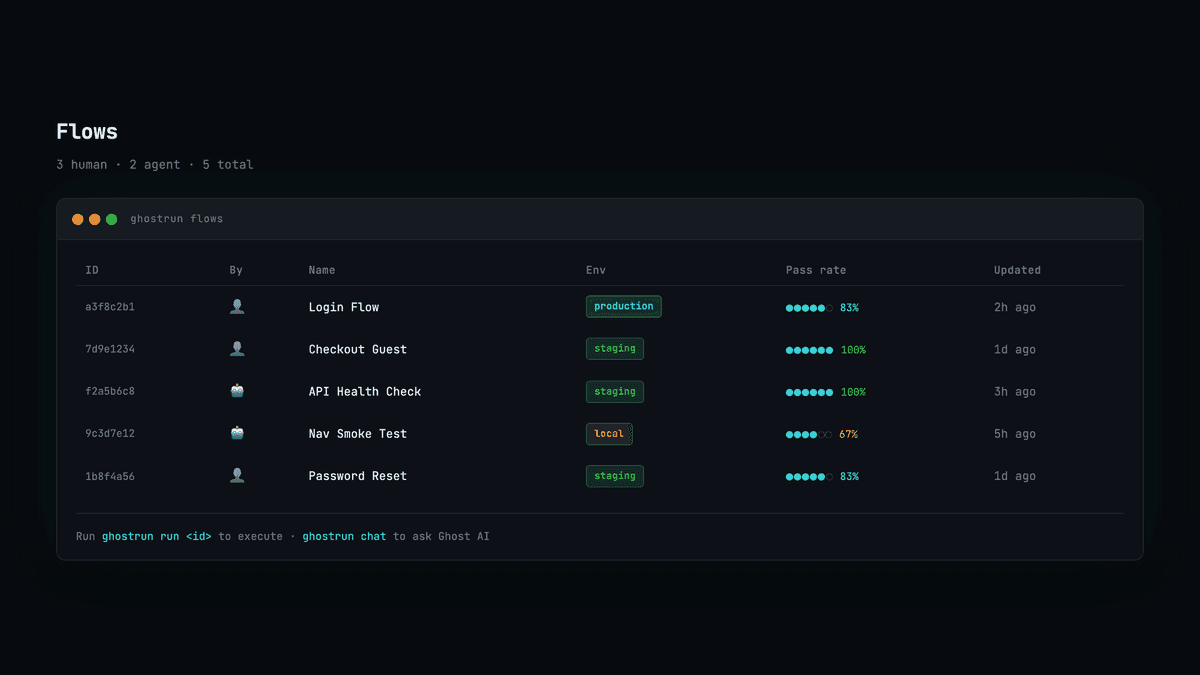
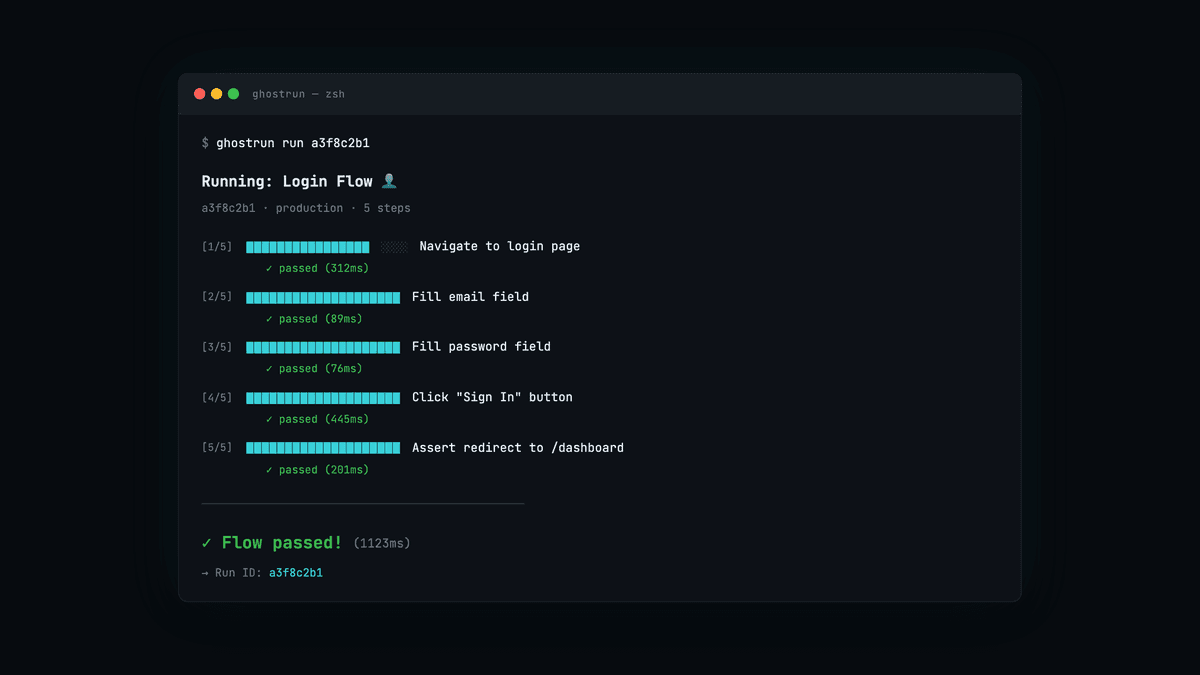
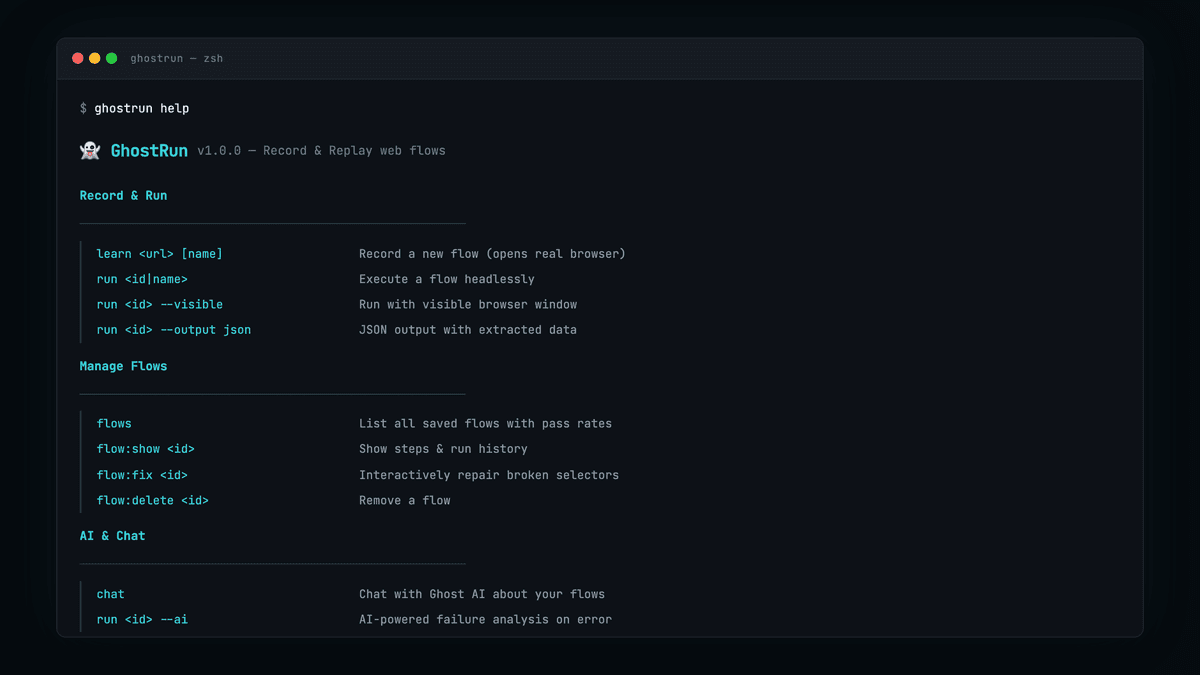
No YAML. No extra framework to learn. Browser automation, API testing, and load testing all run through the same flow format.
Use `ghostrun learn <url>` to open Chrome and record interactions, or write a `.flow.json` for API-only checks. Browser and API use the same flow model.
Replay with `ghostrun run <flow>`. API-only flows skip the browser. Use `ghostrun perf:run <flow>` for VU-based load testing with p50, p95, and p99 stats.
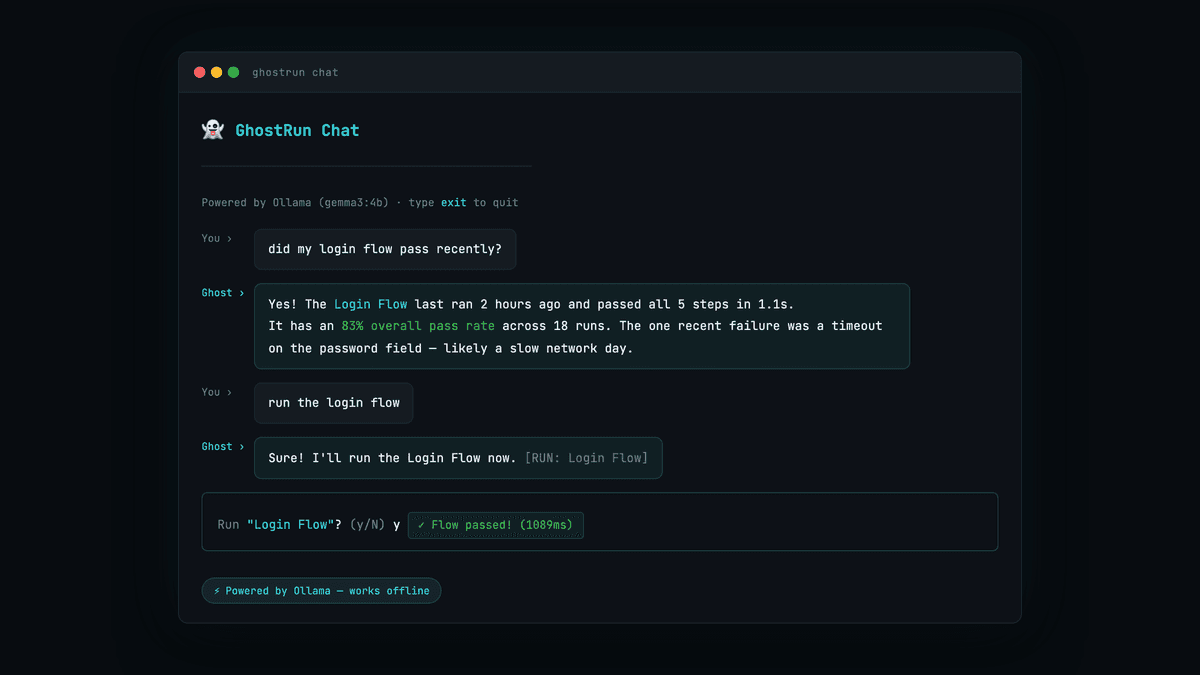
When something breaks, GhostRun can use local Ollama or Claude to explain the failure, summarize the run, and help turn issues into next actions.
AI can default to local Ollama for private, offline-first usage. If neither Ollama nor Anthropic is configured, GhostRun still works as a non-AI CLI.
Ask the built-in bot about flows, prior runs, or failed steps. It understands your local GhostRun workspace and stays offline-first with Ollama.
Schedule extraction flows, compare outputs across runs, and detect what changed without writing custom comparison code.
Agents can run headless, but humans can switch any flow into a visible browser session when debugging a flaky interaction.
HTTP flows support assertions, JSONPath extraction, bearer auth, variable chaining, curl import, and OpenAPI-based starting points.
Turn any API flow into a load test, compare two performance runs, and export to k6 when you need a wider performance workflow.
Switch between dev, staging, and prod profiles without editing the flow itself. Environment values are injected before every run.
Record real browser flows, replay headlessly in CI, and let GhostRun explain failures in language your team can act on.
Model auth flows, assertions, extraction, and environment switching without having to split tooling between browser and backend checks.
Turn API flows into repeatable load scenarios with latency percentiles, request throughput, and k6 export when you need to scale out.
Connect GhostRun through MCP so Claude, Cursor, or other agents can create, run, inspect, and reuse flows autonomously.
Production-ready starter flows for login, auth, health checks, checkout, CRUD, and load baselines. Use them as direct templates, not just examples.
Navigate to login, submit credentials, and assert dashboard access
Register a new account and verify the confirmation state
Open key public pages and confirm they load without issues
Fill and submit a contact form, then assert success output
Add to cart and walk through guest checkout assertions
Hit health endpoints and assert healthy responses
Run a search flow and verify results render correctly
Request password reset and verify the confirmation step
Authenticate, extract token, and call a protected endpoint
Create, fetch, update, and delete a resource in one flow
Establish a p95 and RPS baseline against an API endpoint
GhostRun can track whether a flow was recorded by a human or created by an agent. That makes it easier to let agents generate workflows while still keeping a trust boundary around what gets promoted.
A human can record a login once and let agents reuse it with environment variables. An agent can draft a flow from natural language or code context, then a human can verify and keep it.
Captured in a real browser by a person. Strong for verified interaction paths and trusted baseline flows.
Generated from natural language, code scanning, or exploration. Useful for drafting flows fast, then reviewing or promoting them.
Your flows, screenshots, and run history stay on your machine. The installable package is `ghostrun-cli`; the command you run is `ghostrun`.